Leave Your Message
- Phone
- E-mail
- Whatsapp
- Wechat

-

-

-

-

Sourcing Deep Fried Dough Stick wholesale in 2026 requires more than comparing prices. Buyers must evaluate texture, production consistency, food safety, packaging, and delivery performance. A reliable supplier should provide ingredient specifications, allergen information, production records, and recent quality certificates. Samples matter greatly. A golden, crisp stick may become soft after freezing or during transport.
Chef Zhang Qiang, a veteran Chinese fried-dough producer, says, “Consistent dough creates consistent trust, not just consistent flavor.” This practical view remains valuable for importers, restaurant groups, and foodservice distributors. Ask suppliers how they control dough fermentation, frying temperature, oil replacement, and moisture levels. Request samples prepared from different production batches. Small differences can reveal larger process problems.
In 2026, buyers should compare total landed cost, not only the factory quotation. Include cartons, frozen storage, customs handling, insurance, and possible waste. Confirm minimum order quantities and private-label options before signing agreements. Check whether the supplier can maintain the same size, color, and internal air pockets at scale. Those details affect customer expectations.
The process is not flawless. Supplier websites can look impressive while offering limited evidence. Certifications may also require independent verification. That step takes time. It can prevent expensive surprises.
A strong sourcing plan combines factory visits, documented audits, sample testing, and clear purchase terms. Buyers should also discuss backup production capacity. Weather, equipment failures, and shipping delays still happen. The best Deep Fried Dough Stick supplier is not always the cheapest. It is the one that delivers safe, stable, and commercially usable products repeatedly.
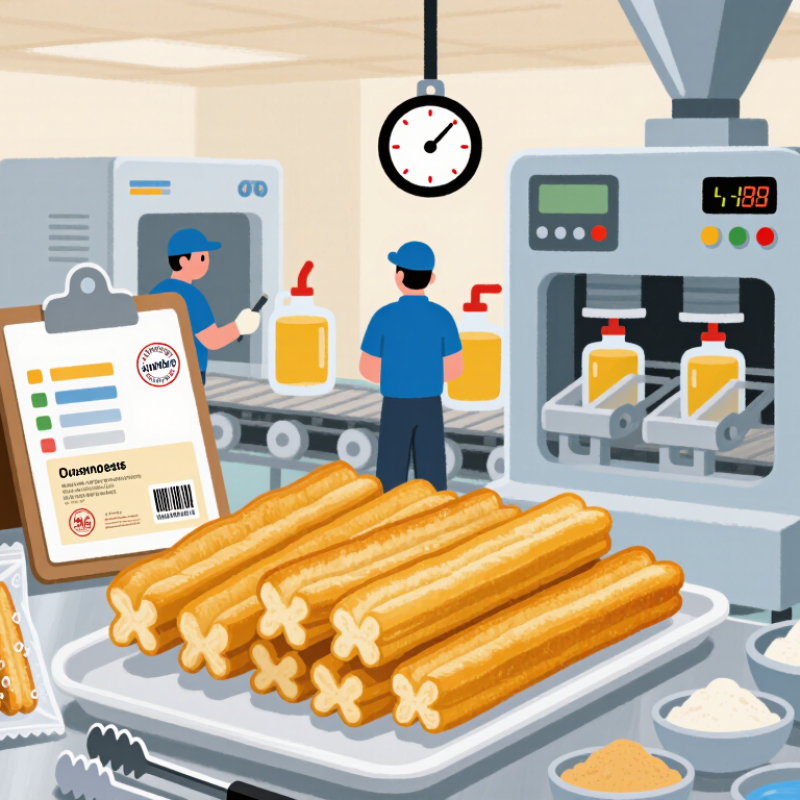
Deep fried dough sticks are not simply fried flour products. Their texture depends on flour strength, leavening, dough resting, frying temperature, and oil control. A reliable wholesale specification should describe each point clearly.
Start with the product format. Confirm whether the sticks are frozen, chilled, or ready to fry. Record the length, weight, diameter, and acceptable size variation. For example, a buyer may request 20-centimeter sticks with a defined weight range. Ask for moisture content, cooking time, frying temperature, and expected expansion. These details affect labor and serving consistency.
Packaging deserves equal attention. Check the pieces per inner bag, bags per carton, net weight, carton dimensions, and storage temperature. Food-grade packaging should protect the dough from freezer burn and crushing. Request ingredient lists, allergen statements, production dates, shelf-life data, and relevant food safety records. Samples should be fried using the same oil temperature found in your kitchen.
A specification sheet can still miss real problems. I have seen dough look attractive before frying but become dense after cooking. That is why visual checks are not enough. Test crispness after five minutes, oil absorption, interior softness, and odor. Ask for batch consistency, but allow a practical tolerance. Perfect uniformity is often promised too easily.
| Specification Dimension | Typical Wholesale Range or Requirement | Why It Matters When Sourcing | Recommended Verification Method |
|---|---|---|---|
| Product Type | Traditional fried dough sticks, commonly sold as ready-to-eat or frozen dough products | Ready-to-eat products simplify service, while frozen dough allows frying closer to the point of sale. | Confirm whether the quotation covers cooked products, frozen dough, or partially prepared dough. |
| Typical Individual Length | Approximately 15–30 cm per stick | Length affects portion size, packaging efficiency, frying equipment compatibility, and serving presentation. | Request a dimensional specification sheet and approve a physical sample before ordering. |
| Typical Individual Weight | Approximately 35–80 g per cooked stick, depending on size and moisture loss | Weight consistency supports portion control, menu pricing, and predictable yield. | Weigh at least 20 sample pieces and calculate the average and weight variation. |
| Shape and Surface | Elongated, lightly twisted or straight shape with a crisp outer surface and aerated interior | Uniform shape promotes even cooking and reduces rejected pieces during quality inspection. | Check samples for cracks, excessive deformation, dense centers, and uneven browning. |
| Color After Frying | Even golden to light brown appearance without burnt edges or pale, under-fried areas | Color is a practical indicator of frying consistency and consumer acceptance. | Evaluate samples under consistent lighting and record the approved color standard. |
| Texture | Crisp or lightly crunchy exterior with a soft, chewy, and porous interior | Texture is one of the main quality attributes for deep fried dough sticks. | Test immediately after frying and again after a defined holding period, such as 15–30 minutes. |
| Moisture Content | Varies by recipe and format; frozen dough and ready-to-eat products should be assessed against the agreed product specification | Moisture influences crispness, shelf stability, freezing performance, and frying behavior. | Use a validated laboratory or moisture analyzer method and compare results with the agreed specification. |
| Frying Temperature | Common commercial frying range: approximately 170–190°C, adjusted for product size and formulation | Correct oil temperature helps balance internal cooking, expansion, browning, and oil absorption. | Run a controlled cooking trial using a calibrated oil-temperature probe. |
| Frying Time | Often approximately 2–5 minutes, depending on thickness, starting temperature, and equipment | Cooking time affects the center texture, final color, throughput, and labor cost. | Record time and temperature together during a repeatable test batch. |
| Oil Quality Requirement | Use food-grade frying oil managed according to local food-safety rules and the operator’s oil-change program | Degraded oil can create off-flavors, dark color, excess smoke, and inconsistent product quality. | Define acceptable oil-management procedures and inspect supplier process records where applicable. |
| Ingredient Declaration | Usually includes wheat flour, water, leavening agents, salt, and cooking oil; formulas vary | Accurate ingredient information is needed for regulatory labeling, allergen control, and customer communication. | Request the current ingredient list, technical data sheet, and allergen statement. |
| Major Allergen Consideration | Wheat or gluten is commonly present; other allergens may depend on the recipe and production facility | Allergen information affects import approval, labeling, food-service handling, and cross-contact controls. | Obtain a signed allergen declaration and confirm segregation or cleaning procedures. |
| Packaging Format | Food-grade inner packaging with a protective outer carton or case; frozen products require suitable cold-chain packaging | Packaging protects the product from moisture, crushing, contamination, and temperature abuse. | Inspect packaging strength, seal integrity, net weight, case dimensions, and pallet configuration. |
| Wholesale Case Quantity | Commonly packed by net weight or by a fixed piece count; the exact quantity should be agreed in the purchase order | Clear case configuration supports freight planning, inventory control, and accurate landed-cost calculations. | Confirm pieces per case, net weight, gross weight, and allowable count or weight tolerance. |
| Storage Conditions | Ambient, chilled, or frozen storage according to the product format and approved label instructions | Incorrect storage can reduce food safety, texture, shelf life, and product performance. | Verify the labeled temperature range and evaluate temperature-monitoring requirements during transport. |
| Shelf-Life Requirement | Must be stated by the supplier for the specific format, packaging, and storage condition; remaining shelf life at delivery should be contractually defined | Wholesale buyers need sufficient time for transport, customs clearance, storage, and sales. | Request shelf-life validation, production-date coding, and a minimum remaining-life requirement at receipt. |
| Batch Traceability | Each shipment should carry a lot or batch code linked to production and quality records | Traceability supports recalls, complaint handling, inventory rotation, and regulatory compliance. | Check that the batch code appears on both the product packaging and shipping documentation. |
| Quality Tolerances | Agree limits for broken pieces, weight variation, shape defects, foreign material, and off-odor | Written tolerances reduce disputes and make incoming inspection objective. | Include measurable acceptance criteria in the product specification and purchase contract. |
| Minimum Order Quantity | Set by production capacity, packaging format, and shipment method; request quotations for several volume tiers | Higher volumes may lower unit cost but increase inventory and storage risk. | Compare trial, standard, and full-container or pallet-level order quantities using landed cost per kilogram. |
| Delivered Cost Calculation | Product price plus packaging, inland transport, freight, insurance, duties, customs fees, and cold-chain expenses where applicable | The lowest quoted unit price is not always the lowest total procurement cost. | Request an itemized quotation using the intended Incoterm and destination. |
| Sampling and Approval | Approve samples for size, appearance, texture, taste, cooking performance, packaging, and labeling before volume purchase | A sample approval process reduces the risk of receiving a product that does not match the buyer’s market needs. | Use a written sample evaluation form and retain an approved reference sample or specification. |
Note: The ranges shown are typical sourcing references rather than universal legal specifications. Final requirements should follow the approved product specification, applicable food-safety regulations, and the destination market’s labeling rules.