Leave Your Message
- Phone
- E-mail
- Whatsapp
- Wechat
-
-

-

-

China’s steamed bun industry is moving beyond traditional wheat-based recipes. Today, specialized manufacturers are developing Gluten Free Steamed Buns for consumers with celiac disease, gluten sensitivity, or carefully managed dietary needs. This guide introduces ten notable Chinese suppliers and examines how they approach formulation, production, packaging, and export support.
Quality begins with ingredient control. Rice flour, tapioca starch, potato starch, and other alternatives must be handled with precision. A reliable manufacturer should separate gluten-free production areas from wheat-processing lines. It should also maintain documented cleaning procedures, batch records, allergen controls, and laboratory testing. These details matter more than attractive catalog images. They reveal whether a supplier can protect product consistency from mixing room to delivery.
The selected companies are assessed through practical business criteria, including factory experience, manufacturing capacity, private-label services, certifications, traceability, and customer communication. Some suppliers may excel at frozen products, while others focus on retail-ready packaging or food-service orders. Not every factory will fit every buyer.
That is important.
A strong product sample does not guarantee stable mass production. Buyers should request ingredient specifications, test reports, production photographs, and samples from different batches. Questions about storage temperature and shipping conditions also deserve clear answers. This review cannot replace an independent factory audit, and available information may change over time. Still, it offers a useful starting point for importers, distributors, retailers, and food brands seeking dependable Chinese partners for Gluten Free Steamed Buns.
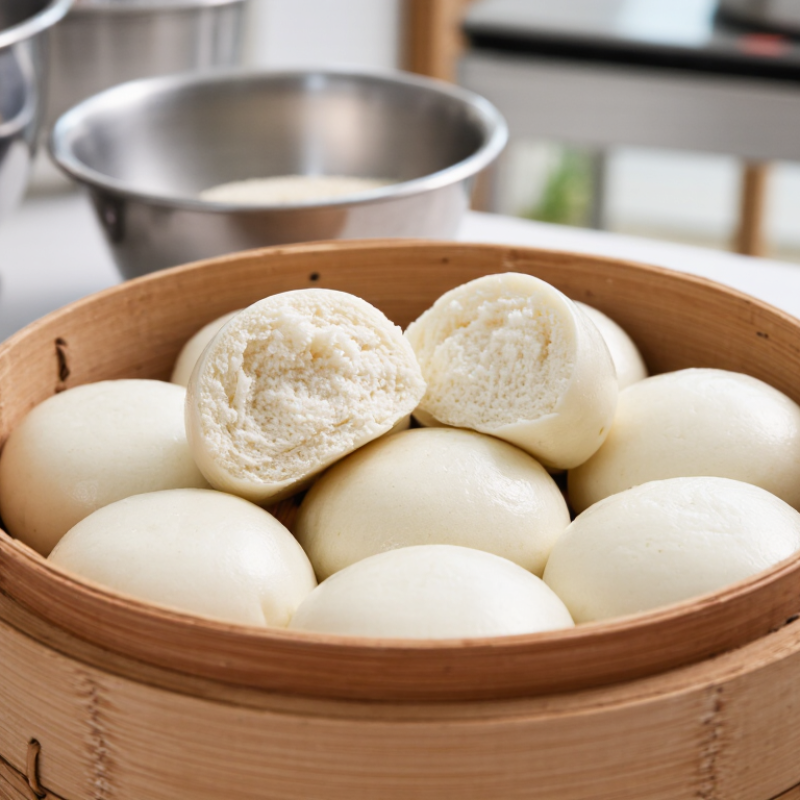
A strong gluten-free steamed bun manufacturer in China begins with process discipline, not attractive packaging. Experienced teams understand that rice flour, tapioca starch, and potato starch behave differently during steaming. They adjust hydration, mixing time, proofing, and steam temperature for each formula. The bun should feel soft, elastic, and moist without becoming sticky. Small changes matter.
Reliable factories control gluten cross-contact at every stage. Dedicated production areas are ideal, but verified cleaning procedures are also important. Workers need clear allergen training and controlled movement between lines. Raw materials should arrive with supplier documents and batch identification. Finished buns require documented testing under the standards of the target market. Gluten testing alone is not enough. Traceability must connect each package to ingredients, equipment records, and production time.
Food safety systems such as HACCP and GMP provide a professional framework. Regular internal audits, environmental checks, calibrated equipment, and retained samples strengthen confidence. Packaging should protect the buns from moisture and accidental contact during transport. Cold-chain planning may also affect texture and shelf life. Steam does not remove gluten. That point is often misunderstood. A factory can have modern equipment and still miss a weak control step. Honest manufacturers review complaints, investigate deviations, and improve procedures instead of hiding imperfect results.
| No. | Evaluation Dimension | Evidence-Based Benchmark | What Buyers Should Verify | Importance |
|---|---|---|---|---|
| 1 | Gluten-Free Control | Finished products should meet the applicable gluten-free threshold. The Codex international reference level is no more than 20 mg/kg gluten for foods labeled gluten-free. | Request recent laboratory test reports from accredited laboratories and confirm the sampling method, test method, product code, and test date. | Critical |
| 2 | Dedicated Production Management | A reliable facility uses segregation, controlled personnel movement, validated cleaning, and documented allergen-control procedures to reduce cross-contact risk. | Review the factory layout, production flow, cleaning records, changeover procedures, and allergen-control plan. | Critical |
| 3 | Food Safety System | A structured food-safety management system should be based on HACCP principles and may be supported by ISO 22000, FSSC 22000, BRCGS, or an equivalent recognized scheme. | Check the certificate scope, issuing body, validity period, covered site, and whether steamed buns are included in the certified activities. | Critical |
| 4 | Ingredient Traceability | Key ingredients such as rice flour, tapioca starch, potato starch, yeast, fillings, and additives should be traceable from approved suppliers to finished-product batches. | Ask for supplier approval records, certificates of analysis, lot codes, incoming inspection records, and a completed mock-recall report. | High |
| 5 | Raw-Material Verification | Gluten-free claims depend on both the formulation and the incoming materials. Supplier declarations alone should be supported by risk-based testing and documentation. | Review specifications for starches, seasonings, sauces, fillings, processing aids, and packaging-contact materials. | Critical |
| 6 | Product Consistency | Commercially suitable steamed buns should maintain consistent weight, diameter, filling ratio, moisture, texture, appearance, and steaming performance across production batches. | Request pilot samples, batch specifications, retention-sample records, production tolerance limits, and independent quality inspection results. | High |
| 7 | Shelf-Life Validation | Shelf life should be supported by documented studies under the intended storage and distribution conditions, including microbiological and sensory evaluation where applicable. | Confirm whether the product is ambient, chilled, or frozen; review stability data, packaging tests, storage instructions, and transport conditions. | High |
| 8 | Packaging and Export Readiness | Packaging should protect the product from moisture, odor, physical damage, and potential cross-contact while meeting the destination market’s labeling and material requirements. | Check packaging specifications, food-contact declarations, carton markings, pallet configuration, barcode capability, and export documentation experience. | High |
| 9 | Customization Capability | An experienced OEM/ODM partner should be able to adjust dough formulation, filling, size, cooking method, packaging format, and labeling without weakening gluten-control procedures. | Ask for minimum order quantities, sampling fees, development timelines, formula ownership terms, tooling requirements, and change-control procedures. | Medium–High |
| 10 | Quality Assurance Transparency | A dependable manufacturer provides clear specifications, batch records, corrective-action procedures, complaint handling, and access to relevant audit or inspection evidence. | Evaluate response time, document completeness, nonconformity handling, customer complaint records, and willingness to support third-party audits. | High |